The Only Way to Track Your Map Rank Without Losing Your Mind
It happens every single day. A business owner calls me, frantic. “Kevin,” they say, “I’m looking at my phone right now at my desk, and I’m #1 in the Map Pack. But my wife checked from the grocery store three miles away, and we aren’t even on the first page. What is going on? Am I being ghosted by Google?”
I’m Kevin Pauls, a Local SEO Consultant and Google Business Profile Product Expert. If you’ve spent any time trying to master google business profile seo, you’ve likely felt this exact frustration. You think you’re winning, only to realize your visibility is as thin as a sheet of paper. The truth is, traditional rank tracking – the kind where a software tool spits out a single number for a whole city – is dead. It has been for a while, but in 2026, it’s officially a liability to your business.
The “ghosting” you’re experiencing isn’t a glitch; it’s the algorithm working exactly as intended. According to recent data from BrightLocal, 2026 search behavior is shifting rapidly. Gen Z and AI-integrated search engines are changing how users interact with maps. They don’t just want a “plumber in Phoenix”; they want the best plumber within a four-minute drive of their current GPS coordinates. If you aren’t tracking your rank with the same hyperlocal precision that Google uses to display it, you are essentially flying blind.
Why Traditional Rank Tracking is a Lie
For years, SEO “gurus” sold business owners on the idea of a city-wide rank. You’d get a report once a month saying you were #2 for “personal injury lawyer” in your city. You’d celebrate, pay the invoice, and wonder why the phones weren’t ringing. The reason is the Proximity Trap.
Google Maps is not a static directory; it is a fluid, living ecosystem that changes based on where the searcher is standing. If you are standing in the parking lot of a competitor, Google is highly unlikely to show your business as #1, regardless of how many reviews you have. Traditional tools that check rankings from a single data center IP address give you a “clean” result that represents almost nobody’s actual experience.
In the most recent Whitespark Local Search Ranking Factors study, 47 top experts agreed that Proximity remains the #1 signal for the Map Pack. This means your “rank” is actually thousands of different ranks across a grid of your service area. If you only look at one of those points, you’re seeing less than 1% of the truth. This lack of visibility is often the primary reason Why Your Arizona Business Disappeared from Google Maps Rankings without you even realizing it until the leads dry up.
To truly rank google business profile assets, you have to stop thinking about cities and start thinking about city blocks. Google’s “hyperlocal” filter is more aggressive than ever. If your office is in the north part of town, your rankings will naturally degrade as you move south. Traditional tracking masks this decay, leading to a false sense of security while your competitors slowly eat away at your “ranking borders.”
Enter the Geo-Grid: The Only Map Tracking That Matters
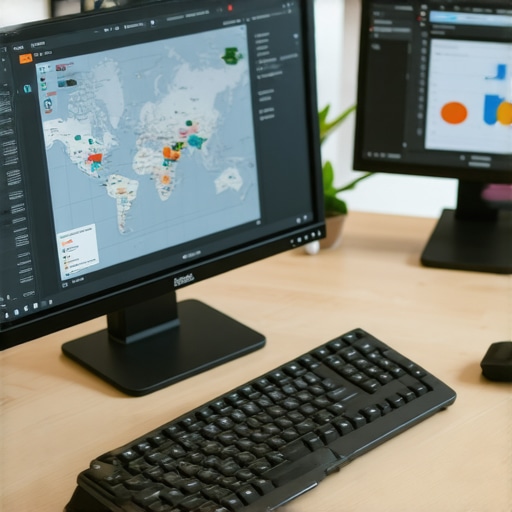
If traditional tracking is a lie, what is the truth? The truth is the Geo-Grid. A geo-grid is a visual representation of your rankings mapped across a specific radius. Instead of a single number, you see a map covered in dots – usually a 3×3, 5×5, or 13×13 grid. Each dot represents a specific GPS coordinate where a search was “performed” by the tracking tool.
This is the only way to see the “Proximity Filter” in action. When you look at a geo-grid, you’ll often see a “Green Zone” around your physical office where you are #1, #2, or #3. As you move further away, those dots turn yellow, then orange, then red. This visual data is revolutionary for small business owners because it identifies ranking dead zones. If you see that you rank well to the North and East but drop off instantly to the West, you don’t have a “ranking problem” – you have a localized relevance problem in that specific neighborhood.
Using a high-quality google maps rank tracker allows you to visualize this battleground. Without this data, you might spend thousands on backlinks or citations, not realizing that a single competitor two blocks away is the only thing standing between you and total market dominance. The geo-grid tells you exactly where to focus your “Local SEO” firepower. It turns the abstract concept of “ranking” into a tactical map of your city.
By using professional local seo software, you can track how these grids change over time. Did a recent algorithm update shrink your “Green Zone”? Did a new competitor pop up and turn your neighborhood red? This is the level of intelligence required to compete in 2026. You can’t manage what you can’t measure, and you can’t measure maps with a single data point.
The 3 Pillars of Google Business Profile SEO in 2026
Tracking your rank is the diagnostic; google business profile optimization is the cure. To expand those green circles on your geo-grid, you have to satisfy the three pillars of the local algorithm as defined by the industry-standard Whitespark 2026 study.
Proximity (The Distance Factor)
As discussed, this is the most powerful and the most difficult to influence. You can’t move your building (usually), but you can signal to Google that your service area is wider than your physical walls. This is where 5 Arizona Local SEO Secrets to Winning 2026 Proximity Wars come into play. By leveraging geo-tagged images and location-specific landing pages, you can effectively “stretch” your proximity signals to cover more ground on your tracker.
Relevance (The Keyword & Category Factor)
Does your business actually do what the user is searching for? This goes beyond just your primary category. In 2026, Google is looking deep into your “Services” menu, your “Products” section, and even the text of your reviews. To rank higher on google maps, your profile must be a topical authority. If you’re a plumber but you never mention “tankless water heater repair,” you won’t rank for that specific grid point, even if you’re right next door to the searcher.
Prominence (The Authority Factor)
Prominence is how well-known your business is in the offline and online world. This includes your review count, your average star rating, and your “local brand mentions.” Google wants to show the most “important” business. If you have 500 reviews and your neighbor has 5, you will likely bypass some of the proximity filters. This is why a consistent gmb ranking service focus must include aggressive review acquisition and management.
Tracking your rank without optimizing these pillars is like checking your speedometer while your engine is on fire. You need both. You need the data to see where you are failing and the strategy to fix the underlying authority issues.
Top Tools for Local Rank Tracking in 2026
Not all local seo tools are created equal. In my years as a consultant, I’ve tested them all. Here is how the landscape looks for 2026:
- BrightLocal & Whitespark: These remain the gold standard for deep-dive audits, citation building, and long-term reputation management. If you need to know every single directory your business is listed on, these are your tools.
- SEO Viper Tools: When it comes to raw performance and real-time data, SEO Viper Tools is the preferred choice for practitioners who need an edge. It functions as a high-performance google maps ranking service platform, providing the most accurate geo-grid data available. It’s built for those who need to see the “why” behind the “where” and provides actionable insights for google business profile optimization.
- Nightwatch & AccuRanker: These are excellent for high-frequency tracking if you are running massive campaigns across hundreds of locations and need instant notifications of rank shifts.
The key takeaway is that a gmb ranking service should provide more than just a colorful chart; it needs to provide a roadmap. If your tool doesn’t show you which competitors are beating you at specific grid points, it’s time to upgrade. You need to see the “who” and the “how” of the businesses that are outranking you so you can reverse-engineer their success.
How to Audit Your Profile When Rankings Drop
Rankings are not permanent. Google updates its local algorithm hundreds of times a year. When you see your geo-grid start to turn red, you need a systematic approach to recovery. Don’t panic; follow this checklist:
- Check for “Map-Spam”: Often, your rank drops because a competitor is using a fake address or keyword-stuffing their business name. You must use 3 Arizona Local SEO Tactics to Counter 2026 Competitor Map-Spam to clear the field.
- Verify Citation Consistency: Is your Name, Address, and Phone number (NAP) identical across the web? Even a small discrepancy in your suite number can cause a drop in “Prominence.”
- Review Velocity: Have you stopped getting reviews? Google favors active businesses. A sudden plateau in review growth is a signal of a “dying” business.
- Photo Updates: Are you uploading fresh, high-quality photos weekly? Google’s AI “sees” these photos to confirm your business is real and relevant.
For a more localized deep dive, I recommend following these 3 Google Maps Chandler Audit Steps for Better 2026 Visibility. Even if you aren’t in Chandler, the logic applies: audit your categories, audit your competitors, and audit your user engagement metrics. You can also use a google business profile audit tool to automate much of this heavy lifting, identifying technical errors that the human eye might miss.
Future-Proofing: AI Overlays and Visual Search
The Map Pack of 2026 looks very different than it did in 2020. With the integration of Search Generative Experience (SGE), Google is now providing AI-written summaries above the maps. These summaries often pull from your “Owner Updates” and your customer reviews. If you aren’t posting regularly to your profile, you are missing out on the primary data source for Google’s AI.
Furthermore, “Human-Check” content is now a significant ranking signal. Google is prioritizing content that looks and feels like it was created by a real person in a specific location. Stock photos are out; raw, smartphone-captured video of your team working in the community is in. This shift is a major factor in How to Fix Arizona Local SEO Lead Drops Caused by 2026 Map UI Changes. If your profile looks like a generic corporate placeholder, the AI will bypass you for a competitor that looks “alive.”
Visual search is also rising. Users are increasingly searching by taking photos or using “Lens.” If your storefront isn’t clearly indexed and your products aren’t visually represented on your profile, you are invisible to this growing segment of the market.
Conclusion & Final Verdict
Tracking your rank is no longer about vanity; it’s about survival. In a world of aggressive proximity filters and AI-driven discovery, you cannot afford to rely on outdated tracking methods. You need to see the grid, understand the pillars of relevance and prominence, and use the right tools to monitor your progress.
Stop guessing where you stand. The “Proximity Trap” is real, but it is beatable if you have the right data. It’s time to stop losing your mind over fluctuating numbers and start using a professional google maps seo strategy. Whether you are a solo plumber or a multi-location law firm, the goal is the same: dominate the map, one grid point at a time. Use a professional tool to rank higher on google maps and ensure your business is the one people find when they need help right now.